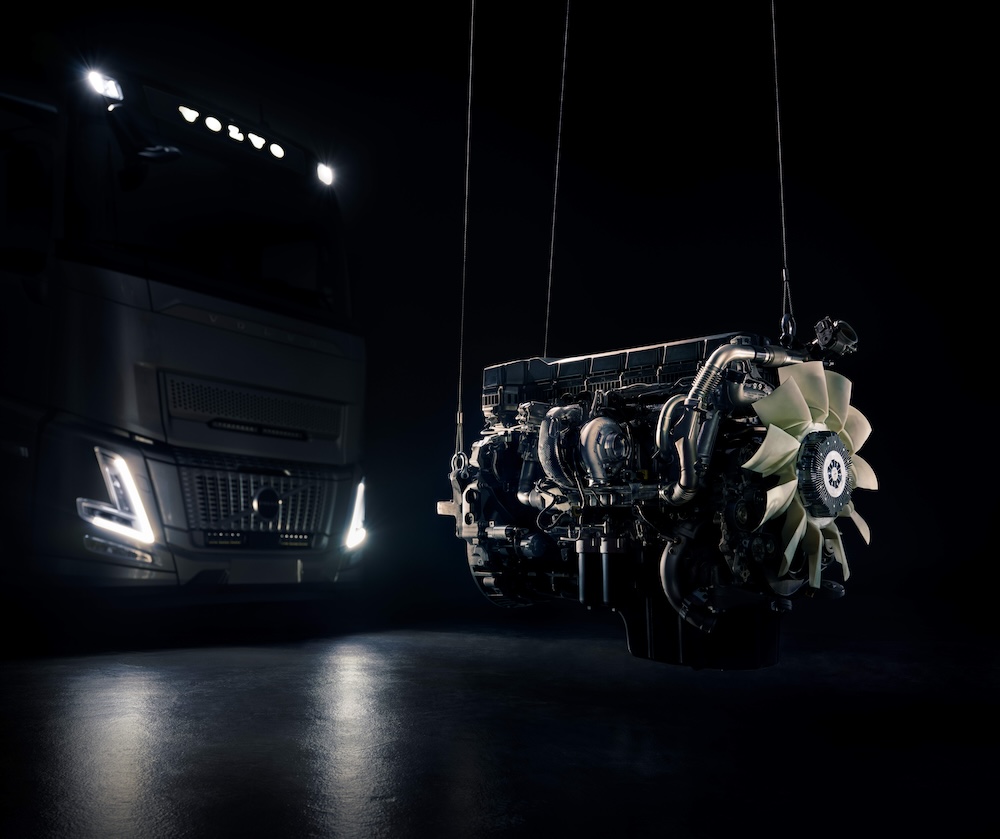
Volvo Trucks has unveiled an all-new 13-litre combustion engine platform promising improved fuel economy, lower emissions and compatibility with a wide range of renewable and low-carbon fuels.
The new platform, which will underpin both diesel and gas-powered models, was launched in Europe this week following the debut of Volvo’s EPA 2027-compliant D13 engine and Mack’s MP13 at ACT Expo in Las Vegas on 4 May.
Volvo says the new Euro-6 engines are its most fuel-efficient combustion powertrains yet, with fuel savings of up to 4% compared with the previous generation when combined with the company’s latest aerodynamic and driveline improvements.
The new engines will be offered across the Volvo FM, FMX, FH and FH Aero ranges from the third quarter of 2026.
“These all-new engines are not only our most fuel-efficient powertrains ever, but they will also take our combustion engine into the future,” said Jan Hjelmgren, head of product management at Volvo Trucks.
“The flexibility and readiness for all existing diesel and gas fuels, and also future hydrogen applications, means that we can offer efficient trucks with the possibility of net-zero emissions to all our customers globally.”
The new platform has been engineered to run on a wide range of fuels including biodiesel/B100, HVO, biogas/bio-LNG and, in future, hydrogen.
Volvo says the engines feature new cylinder and turbocharger designs, improved engine braking performance and an updated version of the I-Shift transmission. Higher torque outputs are also promised across both diesel and gas variants.
The diesel D13 engine will be available with outputs from 380hp to 560hp and torque ratings from 1,800Nm to 2,900Nm. The gas-powered G13 will offer between 420hp and 500hp with torque outputs from 2,400Nm to 2,800Nm.
Many versions of the D13 will also support Volvo’s I-Roll system with engine stop/start functionality, allowing the engine to shut down while coasting downhill to further reduce fuel consumption.
Volvo said the engines have been designed to meet future legislation as well as the latest Euro-6 noise regulations under NNR3.
Production will initially take place at Volvo’s Skövde engine plant in Sweden, with trucks assembled in Tuve and Ghent.
The engines will be rolled out globally in stages, beginning with Europe, Morocco, Turkey and India before expanding to North and Latin America, Asia and Africa.
Related used vehicles for sale




_12-05-2026-02-11-26-591.png)
.jpg)